How to Find the Right Fresh Milk Coffee Vending Machine in Chennai for Your Office
Choosing a coffee vending machine for your office involves more than finding one that prepares coffee quickly. Employees want good-quality coffee throughout the workday, while facility managers need equipment that is easy to maintain, fits the available space, and meets daily demand.

Introduction
Choosing a coffee vending machine for your office involves more than finding one that prepares coffee quickly. Employees want good-quality coffee throughout the workday, while facility managers need equipment that is easy to maintain, fits the available space, and meets daily demand.
If your office prefers coffee made with fresh milk rather than instant premix, look for a machine designed to prepare fresh milk-based beverages. But this depends on the individual offices because each office has its own needs and specifications. The size of your workforce and its daily coffee consumption will help determine which machine is right for your office.
For those who need a fresh milk coffee vending machine in Chennai, having knowledge about the capabilities of the machine, its capacities, cleaning processes, and maintenance is very important before making an appropriate choice. In this guide, we discuss various aspects to take into account while buying a coffee vending machine.
1. Understand Your Office Coffee Requirements
Before evaluating different machines, consider how coffee is consumed in your office. Your selection should depend on your employees' needs and the volume of coffee they consume.
Estimate daily coffee consumption
Begin by determining the number of workers who take coffee often. Also take into account visitors and clients as well as people working in various shifts.
For example, an office with 40 employees may need a machine that can meet coffee demand throughout the workday. Another example would be a bigger office with hundreds of employees who will require coffee machines to be more efficient around lunch times.
Here are some questions you should ask:
- •How many cups are needed on an average working day?
- •Does coffee consumption increase during specific hours?
- •Is the machine going to be used by just one department or the whole office?
- •Do the employees want regular coffee, stronger coffee, or even milk-coffee types?
Your answers will help you narrow down the available options.
Consider the available space
Check the counter space, power source, and the water supply needs, among others. Fresh milk coffee machines also have specific space needs, depending on their specifications.
A machine that can be comfortably accommodated in the pantry and cleaned up by the employees is recommended.
2. Choose a Machine That Uses Fresh Milk Effectively
One reason offices choose fresh milk coffee machines is the taste and texture they can offer compared with drinks prepared using instant premixes. Fresh milk makes for creamier coffee and gives an authentic coffee taste that employees might appreciate.
It is worth mentioning, though, that different coffee machines treat milk differently. There are machines that come with their own milk boiler, and there are other models that feature an integrated approach to milk handling.
Check the milk preparation system
Ask how the machine heats, stores, and dispenses milk. In addition, check on the need for adding milk by hand, whether a boiler comes separately or the cleaning process that should be done after use.
Fresh milk requires proper temperature control to maintain its quality and safety. Ask the supplier whether the machine has an integrated refrigeration system or requires separate milk storage, and follow the manufacturer's cleaning and storage instructions.
Look at the beverage options
Determine the type of beverages that the machine serves – coffee only or other beverages as well. Some companies require a coffee machine only, while some others need both coffee and tea machines in one place.
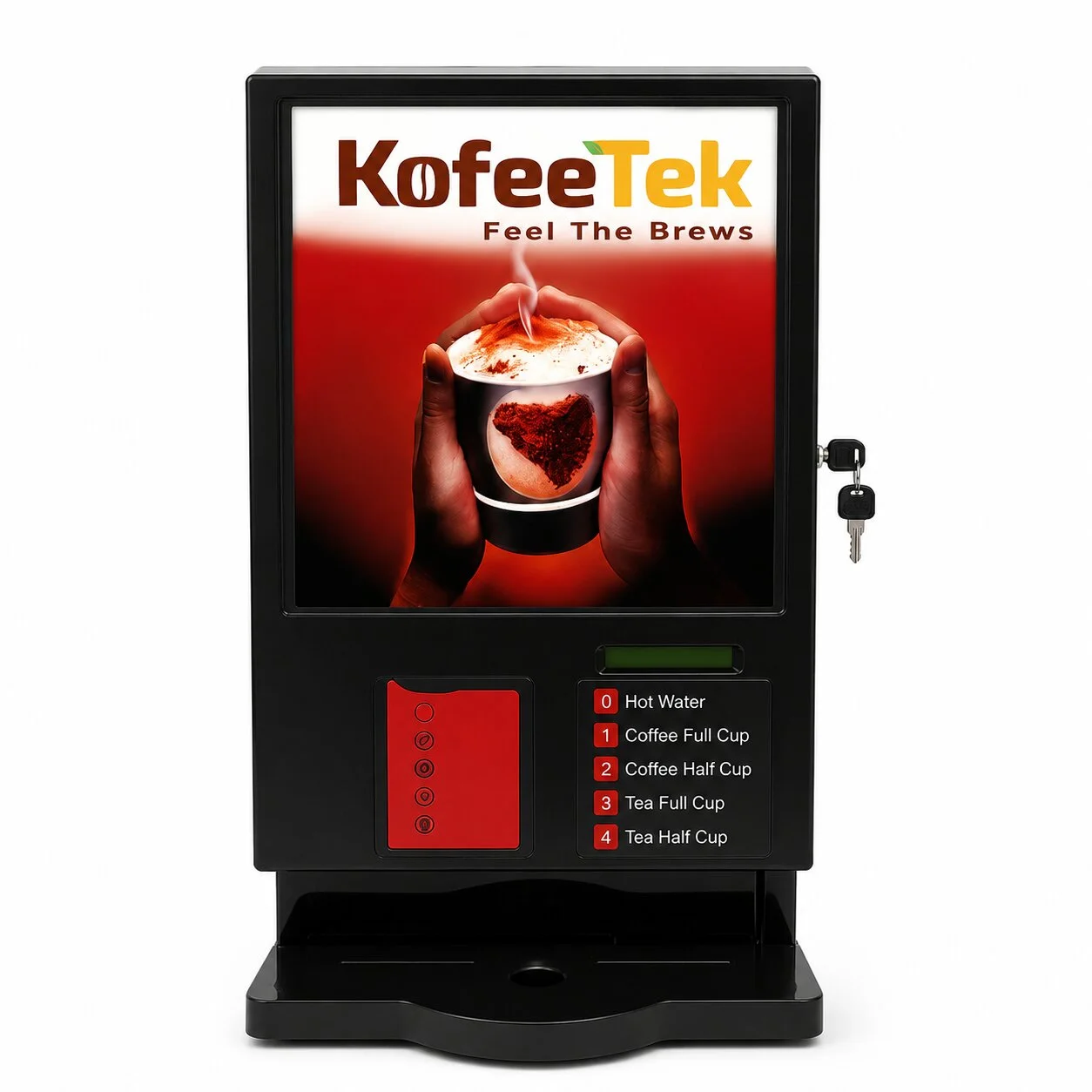
KofeeTek's coffee vending machine options are a useful starting point when comparing workplace beverage equipment.
3. Check the Machine's Daily Capacity
A machine's capacity will certainly narrow down the list of machines available to you, but this alone should not be the sole reason for your choice. Also, the time it takes for your employees to prepare their drinks, along with the capacity of the machine to handle busy periods should be considered.
For example, a high-capacity coffee vending machine may suit a busy office. However, check the machine's daily output and peak-hour performance to ensure it can meet your employees' coffee requirements.
Match capacity to employee numbers
If the evaluation process involves a new machine that dispenses fresh milk coffee in Chennai, then it is advisable to consult the vendor on how frequently the machine should be used.
Key considerations include the following:
- •Small offices: A compact machine may be suitable when daily coffee demand is relatively low.
- •Medium-sized offices: It would be necessary to have machines with a higher capacity due to regular pantry activity.
- •Large offices and factories: High-capacity machines may be more suitable for workplaces with heavy demand or multiple shifts.
Do not choose a machine just by considering the highest number of cups indicated in its specification. Find out how it works under the same environment where you operate.
4. Evaluate Cleaning and Maintenance Requirements
Cleaning becomes even more critical when the coffee machine requires fresh milk. If the machine is not cleaned on time, the residue of milk will accumulate in the dispensing system, resulting in the problem of sanitation and quality of the next cup of coffee.
Before buying or renting the machine, make sure you know all about the cleaning procedure and its maintenance services.
Ask about automatic cleaning features
There are models which provide the automatic cleaning cycle, which makes their routine maintenance easier. Nevertheless, this does not mean that there is no need for a manual clean and inspections.
It is suggested to ask the supplier to show the cleaning process prior to installation. The pantry team will be able to perform the cleaning procedure independently.
Check the service arrangements
Even a well-maintained machine may occasionally need repairs or replacement parts. It's therefore important to find out who will be responsible for the servicing and how fast you will get support.
A clear service agreement can help minimise downtime when the machine needs maintenance or repairs.
5. Compare Buying and Rental Options
Buying a machine is not the only way to provide fresh coffee at work. Renting may suit businesses that prefer monthly payments or want to assess their long-term requirements before making a purchase.
When buying makes sense
Purchasing a machine may suit offices with consistent coffee demand and long-term requirements. You will be able to own the equipment and use it according to the requirements of your office.
Do not forget to consider installation, service costs, maintenance and extra equipment for milk storage.
When renting may be suitable
It might be advisable to consider rent if your workforce is expanding, your needs are not yet determined, or you are looking to keep away from a heavy initial outlay on equipment.
Take into account the length of rent, monthly payments, maintenance conditions, expendables, and termination conditions.
You can also explore KofeeTek's coffee vending machine rental options to see whether renting suits your office.
6. Consider the Total Cost of Daily Operation
The initial purchase price is only one part of the overall cost. A machine that appears suitable at first may involve additional expenses for milk storage, cleaning supplies, repairs, and spare parts.
Before settling on a fresh milk coffee vending machine in Chennai, make sure you get a list of the operating expenses.
Include the following in your comparison:
- •Machine purchase price or monthly rental charge.
- •Fresh milk and coffee consumption.
- •Electricity and water requirements.
- •Cleaning materials and routine maintenance.
- •Servicing charges and replacement parts.
- •Installation and any additional equipment.
The estimated cost of production per cup can also be helpful. Divide your estimated daily operating costs by the number of cups served each day to calculate an approximate cost per cup.
This way, you can make comparisons between the various coffee machines according to how they will be used, and not just according to their purchase cost.
7. Check Product Quality and Supplier Support
Choosing the right supplier is just as important as choosing the right machine. The right machine must have operating instructions, serviceability, and availability of the consumables that would be needed on an everyday basis.
Ask the supplier for a live demonstration and prepare a few questions before making your decision.
Ask whether employees can test the machine before purchase. You should also check spare-part availability and whether staff training is provided during installation.
It is always good to consult the manufacturer's specifications and quality papers. If needed, do not rely on all models having the same certifications and inquire about food safety from the supplier.
KofeeTek provides workplace beverage equipment and consumables for different business requirements. You can browse its range of beverage products to explore the available options.
8. Make the Final Decision Based on Your Workplace
After shortlisting a couple of models, compare them based on your initial requirements. Comparing shortlisted models will help you avoid paying for features your team rarely uses or choosing a machine that cannot meet daily demand.
| What to check | What to look for |
|---|---|
| Daily capacity | Suitable output for your workforce |
| Milk system | Practical milk storage and preparation |
| Cleaning | Clear daily cleaning instructions |
| Beverage choices | Options employees will actually use |
| Maintenance | Defined servicing and support |
| Running costs | Predictable daily operating expenses |
| Installation | Suitable space and electrical arrangements |
| Payment terms | Clear purchase or rental conditions |
If it is possible, arrange for the demo first prior to purchase. Ask the pantry staff to test the machine alongside the purchasing team. They can identify practical issues related to refilling, cleaning, and daily operation.
Those who work at offices searching for a new milk coffee vending machine in Chennai will do well with a machine suited for their drinking habits and budget.
Conclusion
Choosing the right fresh milk coffee vending machine for your office starts with understanding your employees' coffee preferences, daily consumption, and available pantry space. You should also consider milk storage, cleaning requirements, machine capacity, and after-sales support before making a decision.
Rather than focusing only on the purchase price, compare the total operating costs and check whether the machine can handle peak-hour demand. Request a demonstration and clarify the maintenance arrangements with the supplier.
By considering these factors, you can choose a machine that suits your workplace requirements and provides employees with convenient access to quality coffee throughout the day.
Frequently Asked Questions
A fresh milk coffee vending machine prepares coffee using fresh milk rather than relying solely on powdered milk premixes. The exact preparation method depends on the machine's design.
Yes. A fresh milk coffee machine can suit a small office if its capacity, installation requirements, and cleaning needs match the team's requirements.
The daily output depends on the machine model. Some machines are designed for a few hundred cups per day, but you should confirm the manufacturer's capacity rating and peak-hour performance.
Clean the machine according to the manufacturer's instructions. Fresh milk components may require frequent cleaning to maintain hygiene and beverage quality.
Fresh milk must be stored at the appropriate temperature. Whether you need a separate refrigerator depends on the machine's milk storage and refrigeration system.
Buying may suit offices with consistent, long-term demand, while renting may be preferable for businesses that want to spread costs over monthly payments. Compare maintenance, service, and contract terms before deciding.
Consider daily capacity, milk handling, beverage options, cleaning requirements, installation, operating costs, warranty coverage, and local service support before choosing a machine.
You can visit KofeeTek to explore workplace beverage solutions and contact the team to discuss your office's coffee vending machine requirements.